
2026-10-16 · Smart Agricultural Technology
ZLab collaboration advances intelligent crop disease recognition with TaxoSeg
TaxoSeg combines structured crop-disease knowledge with a pretrained vision-language model to locate lesions and identify diseases in complex field images.
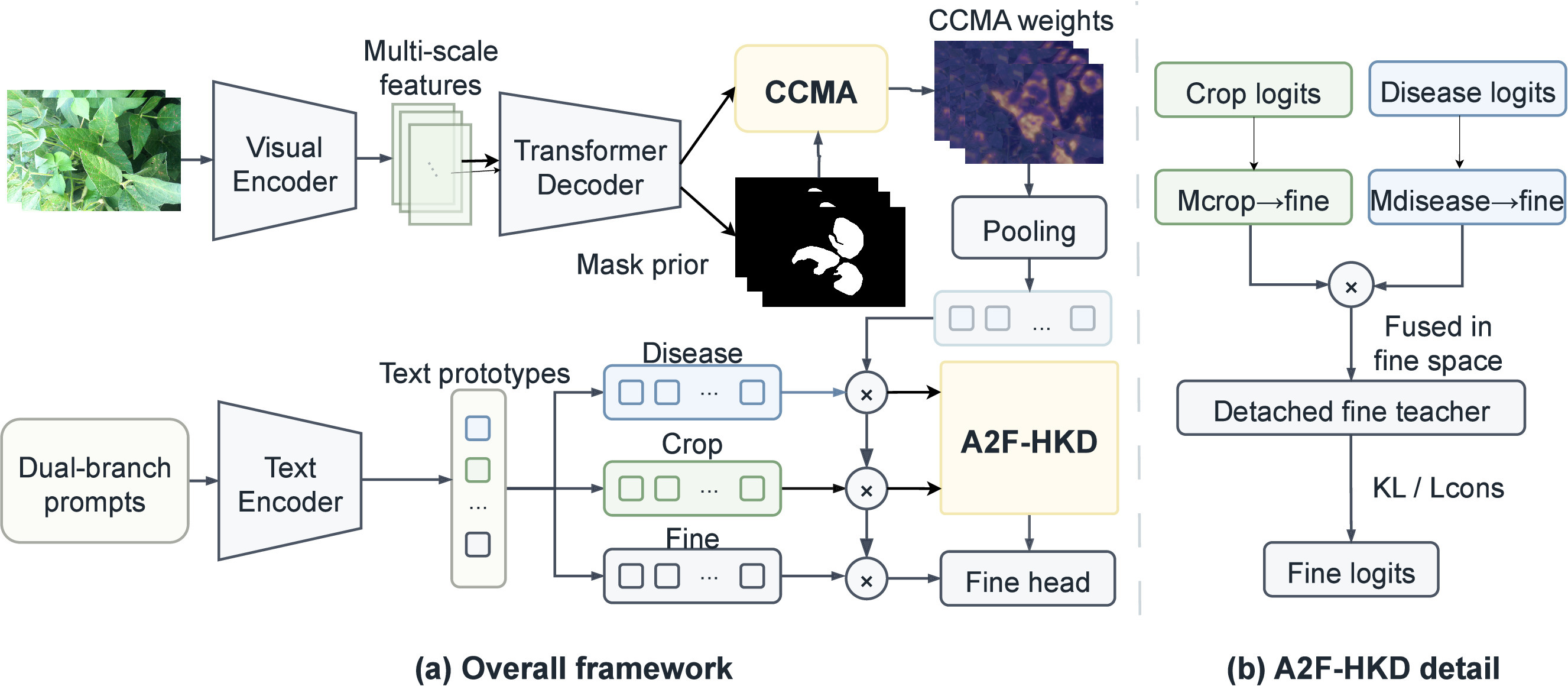
Figure 1 | Overall architecture of TaxoSeg. Visual feature extraction, crop conditioning, structured text prototypes, and hierarchical knowledge distillation work together to localize and classify crop disease lesions.
ZLab professors Zhen Chen and Gensheng Dou have collaborated on a study published in Smart Agricultural Technology titled “TaxoSeg: Taxonomy-aware crop disease segmentation via structured semantic prototypes.” The team introduces a crop disease segmentation framework that combines structured semantic knowledge with a pretrained vision-language model for accurate lesion detection and diagnosis in complex field conditions.
Fast and accurate crop disease recognition supports food security and smart agriculture. In field images, cluttered backgrounds, variable lighting, diverse lesions, and similar symptoms across crops make fine-grained diagnosis difficult. Treating each crop-disease combination as an unrelated class also overlooks the relationships among host crops, diseases, and symptoms.
TaxoSeg uses visual and text branches. An image encoder and Transformer decoder extract multiscale features and generate lesion masks, while the text branch turns crop classes, disease types, and symptom descriptions into structured semantic prototypes. A Crop-Conditioned Mask Adapter (CCMA) uses crop context to strengthen lesion features. Auxiliary-to-Fine Hierarchical Knowledge Distillation (A2F-HKD) guides fine-grained classification with crop- and disease-level predictions, and dual-branch text prototypes help distinguish similar symptoms.
Across public datasets and an independently collected field dataset, TaxoSeg achieved 48.48% mean intersection over union (mIoU) on PlantSeg115, 10.40 percentage points above the same-backbone baseline. On WheatField-Seg, it reached 67.77% mIoU without training or model selection using target-domain data, supporting its ability to transfer across field settings.
By incorporating crop disease taxonomy into an AI vision model, the study offers a route to more precise disease monitoring, targeted crop protection, and agricultural decision support.
Erkun Zhang is the first author; ZLab professors Zhen Chen and Gensheng Dou are co-corresponding authors. The work was supported by the National Natural Science Foundation of China (32570482).
Publication
Zhang, E., Cheng, J., Zhang, Z., Wang, K., Ding, Z., Liu, Y., Tang, J., Dou, G., & Chen, Z. (2026). TaxoSeg: Taxonomy-aware crop disease segmentation via structured semantic prototypes. Smart Agricultural Technology, 15, 102611.