
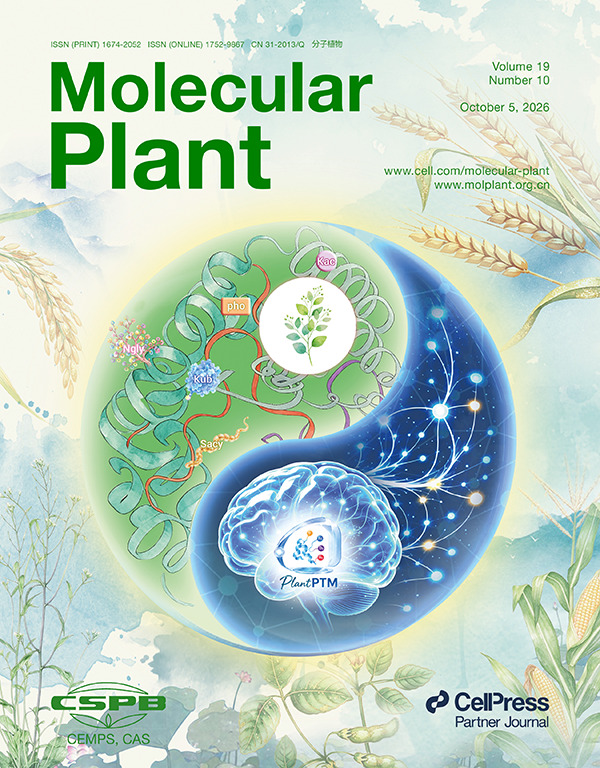
Welcome to PlantPTM
PlantPTM is the first integrated deep-learning framework for large-scale prediction of plant post-translational modification (PTM) sites. By combining protein language models, multi-view deep learning, and evolutionary information, PlantPTM enables accurate prediction of nine major PTM types, including N-glycosylation, S-acylation, 2-hydroxyisobutyrylation, crotonylation, malonylation, succinylation, acetylation, ubiquitination, and phosphorylation across six representative plant species: Arabidopsis thaliana, Oryza sativa, Triticum aestivum, Zea mays, Glycine max, and papaya.
Designed for both model and non-model plants, PlantPTM demonstrates strong generalization ability in crops such as wheat and tomato, supporting proteome-scale PTM analysis and functional discovery in diverse plant species. Independent in-house mass spectrometry (MS) validation further confirmed the reliability of PlantPTM predictions for N-glycosylation, acetylation, and ubiquitination sites.

Please go to the Predict page to submit FASTA text or upload FASTA file for batch prediction.
Please go to the Citation page to view the citation information of this article.
Please kindly cite our study
Dou, G., Wang, K., Qin, Z., Zhang, M., Zhang, W., Miao, C., Li, J., & Chen, Z. (2026). PlantPTM: A deep-learning framework integrating protein language models with multi-view features for predicting diverse post-translational modification sites in plants. Molecular Plant, 19(10), 1979–1995. https://doi.org/10.1016/j.molp.2026.08.002